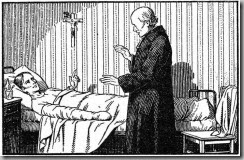
 Estelle announces the abbot she will be cured on Saturday, he does not want to believe it.
WE have been looking at Pellevoisin as it stands in the matter of physical cures in relation to other great shrines and sites of pilgrimage. We will now look at it in a domain which seems to be more especially its own, namely, that of dealing with persons considered to be suffering from demoniacal possession. The bare idea of such possession may bring a smile to the lips of the present-day reader, Catholic though he be. Yet theologians now, as in the past, are by no means inclined to deny the existence of devil-possessed persons. There are curious maladies abroad for which medical science can find no name, but which it classes with more or less fitness under the heads of hysteria and neurosis. When, on those who are the victims of such diseases, the Church allows exorcism to be applied, we may be sure of the nature of the evil that is more than suspected. Victims of maladies of this kind are not so rare as might be at first supposed.
At the present time the dioceses of Blois, Tours, and Angers can each point to what is considered a devil-possessed person in its midst, on whom the Church's exorcisms are being vigorously applied. More than this, were M. de Haza, S.J., an official exorcist for the diocese of Paris, to be consulted, and were he to answer confidentially, he might tell us that now, in the spring of the year 1903, he has sixteen persons on hand whom it is his task to exorcise.
We will see what Pellevoisin has to say on this subject. One of the remarkable cures it can point to in this direction is that of Francoise Millet, the daughter of peasant parents living at Carmagne, not far from Bourges.
In 1882, Francoise, a little girl of twelve, was suffering from a form of disease which the doctors of the locality were at a loss even to understand. The child was daily subject to attacks, which in no way resembled those of epilepsy, and which would sometimes last for hours together. At such times she would writhe in contortions.
At such times, too, she knew how to bark like a dog, to mew like a cat, and to crow like a cock. The sight of sacred objects had the effect of sending her into paroxysms of rage. She possessed the power of second sight to a remarkable degree. According to the testimony of persons concerned in her case, she often had knowledge of things that were going on at a distance, as well as intuition of events that were to happen.
The doctor's advice to the parents was to put the child in a madhouse, and the advice might have been acted upon but for the timely interference of the Rev. Father Jean-Joseph, of the Franciscan convent of Bourges.
This religious, having heard of the little Francoise, expressed a wish to see her. On seeing her, he at once believed himself to be in presence of a case of devil-possession. He said to the parents : "Take her to Pellevoisin, and, should it be that she is tormented by the devil, the Blessed Virgin will deliver her."
Accordingly, the parents took their child the following Thursday to Pellevosin. There, the next day, in the Chapel of the Apparitions, a Mass was celebrated for the little devil-possessed girl, as she was called. Fran9oise was present at it. Immediately afterwards she said to Abbe Salmon, the parish priest : " While you were saying Mass, the Blessed Virgin said to me : ' My child, you will be cured on Sunday next at eleven o'clock.' '
" Child," said the priest, "how did you hear these words? Was it with your ears? "
"No, sir, it was with my heart. Within me I heard a clear gentle voice say : ' My child, you will be cured on Sunday next at eleven o'clock." The priest was the more impressed by what he heard, since he knew that the child's words perfectly agreed with the teachings of mystical theology, which tell us that words can be conveyed to the inner sense otherwise than by the ears.
Francoise Millet returned home, and was worse than usual the following- day.
By the much-waited-for hour of eleven on Sun day morning there was no improvement in her condition.
The parents began to look upon the predicted cure as an illusion. It did not occur to them that before Sunday was at an end the clock had again to strike the hour of eleven. At nine o'clock the family went to bed as usual, Francoise going to her little room alone.
The child fell into a deep sleep. At eleven o'clock she awoke. To use her own words : "Just as the train was passing, and it passes at eleven, I was awakened by two little taps on my side. I was not at all afraid. I then heard in my heart, in the same way as at Pellevoisin, the words spoken very softly and distinctly : “ My child, you will have no more attacks ; but you will suffer from headaches and sickness until you come and see me again."
From that hour the terrible fits, of which she had had at least two daily for more than a year, ceased completely ; but she began to be troubled with headache and sickness. This continued until her second visit to Pellevoisin. Then every sign of ailment and suffering disappeared, and Francoise Millet returned home perfectly well. The cure is attested by a marble ex voto in the chapel of the Apparitions.
The following year, on September 9th, the little girl and her parents were at Pellevoisin on a pilgrimage of thanksgiving. Amid the number of persons assembled there for the annual pilgrimage was a young woman of twenty-five, suffering much in the same way as Fran9oise Millet had suffered. These two were brought together. The child delivered was made to kneel beside the woman still in torture and to pray for her deliverance. This took place in the Chapel of the Apparitions, which was at the time crowded.
The young woman, Marie Saboureau by name, was suffering from a malady for which doctors could find no name, but which priests did not hesitate to call possession by the devil. She was the daughter of peasant parents, and a native of Rivesaltes in the Pyrenees Orientales. At the time of which we write, she was at Pellevoisin under the care of a lady, Madame Gabaudan, of the town of Lunel, who was accompanied by her son. It is to this gentleman that we owe the interesting details on the subject that have been published in the form of a booklet at Montreal, under the title of Histoire d’une possedee guerie par Notre-Dame tie Pellevoisin.
M. Gabaudan was not only a witness of, but an actor in, some of the scenes he describes. More over, his testimony is corroborated by that of others who were witnesses at Pellevoisin of the different phases of this most curious case. Among these may be mentioned Abbe Salmon, cure of Pellevoisin, and the Rev. O. Leborgne, S.M., of the Institution Saint-Vincent at Senlis.
Marie Saboureau had from her youth been pious and strictly virtuous. Apart from those times when she seemed to lookers-on to be possessed by evil spirits and to be serving as their mouth-piece, she was in every respect an exemplary Catholic. At times she would say : " He may possess my body, but he shall never possess my soul." In her moments of reputed devil-possession, and these were many, she would sometimes roll in mad contortions, sometimes roar and bellow like wild animals, and almost always go into a state bordering on frenzy at the sight of sacred objects. At such times startling revelations would come from her lips, and though only an ignorant peasant girl, she would show an intimate acquaintance with the Latin tongue.
When we find her at Pellevoisin on September 9th, 1883, she had already been there three weeks. Among the scenes of Satanic significance enacted by her during that time, there is one that deserves mention. She was in the Chapel of the Apparitions with a few persons, including the cure of Pellevoisin. Rising suddenly, she exclaimed: " Give me water ! I thirst! I burn ! " Her eyes seemed ready to start from their sockets, while her wide-open mouth allowed full view of a swollen tongue and palate. Writhing in rage, she again cried out : “ Give me water ! I thirst! I burn ! "
Abbe Salmon moistened her lips with a few drops of holy water.
“ Give me water ! I thirst ! I burn ! " she continued. Then, turning towards M. Gabaudan, she said: “Give me to drink; I burn!" Here she fell her full length on the ground in contortions.
Another significant feature was Marie Saboureau's persistent refusal to perform the slightest act of homage in presence of the Blessed Sacrament. On one occasion, seven persons together could hardly succeed in making her bend the knee before the tabernacle. Once, when such an attempt was being made, she was heard to say: "For me, no hope, no throne, no glory." In presence of this scene, the words of the devil-possessed of the Gospel come instinctively to the mind: “ What have I to do with Thee, Jesus, Son of the Most High God ! "
In certain of her performances, the girl would move forward on her back with a zigzag movement without the slightest action on the part of hands or feet, and giving forth at the same time a hissing sound like that of a serpent. At such times, she would climb the altar rails and get to the other side as a real serpent might have done.
At the time of the annual pilgrimage, different priests applied the Church's Liturgical prayers to Marie Saboureau's case, but with no other result than that of eliciting still further proofs that they had to do not only with an undoubted, but with also a very remarkable instance of demoniacal possession. One of the priests who thus employed his efforts in contending with the unseen enemy, that was supposed to be acting and speaking in the young woman's body, was the Rev. Father Feuillet, of the Order of St. Dominick. The knowledge of the Latin tongue evinced by the, girl on these occasions was simply astounding. She was ready at once with a reply to each of the Liturgical adjurations. More than one night was spent in prayer at Pellevoisin by those trying to obtain her deliverance.
We now come to the last act of the drama. On the evening of September 15th, the tormented one was in the Chapel of the Apparitions with a certain number of persons, including the cure of Pellevoisin and others, who had been carefully watching her case. To those experienced in such matters, there were signs that the deliverance was at hand. In the meantime, prayer for her did not cease. For three consecutive hours she was a prey to violent convulsions. At eleven o'clock, these suddenly ceased, and she became calm. After this she seemed to see what the rest could not see. To lookers-on, it was as if her infernal enemy were near, though no longer possessing power over her body. After a little while, she fell on her knees before a statue of the Blessed Virgin and, in a voice broken by sobs, said: "O my good Mother, come to my help ; drive away this evil spirit; I am your child ! You know that I renounce the devil, and that I detest him. O my Mother, do not forsake me !" With this, she turned in the direction in which her enemy seemed to be, and said in a loud voice : “ In the name of Our Lord Jesus Christ, go ! " During this last scene she seemed to belong to another world. Coming back to herself, she spoke and smiled, and thanked those around.
All was over, the Salve Regina was sung in thanksgiving, and Marie Saboureau was once more the good pious girl she had been. She entered the service of Madame Gabaudan, to whom, after Heaven, she owed her deliverance. She remained with this lady twelve years, her mistress looking upon her, in the meantime, more as a daughter than as a servant.
At Pellevoisin, in the autumn of 1902, we were witness of facts and experiences similar to those just described.
A striking case belonging to this class of phenomena came before our notice in 1896. It was supported by the testimony of Canon Ferdinand Brette, of the Paris cathedral of Notre-Dame, who, by the way, is an acknowledged authority on psychical matters. Canon Brette preached that year at Pellevoisin on the occasion of the annual pilgrimage thither of September 9th. At his instance, a person was earnestly recommended to the prayers of the assembled pilgrims. This person was a certain Madame B , of Paris, whom he had been exorcising at intervals for four years, and who, in his opinion and that of others, gave unquestionable signs of demoniacal possession. She was completely cured—or delivered, if the reader prefers the term—on the morning of September 9th, the great day of the pilgrimage and the anniversary of the revelation of the scapular. In the meantime, Madame B , though wearing the scapular, but without knowing its origin, was ignorant of every thing concerning Pellevoisin, even to the name of the place. The details of her most curious case were given in full by Canon Brette in a letter to Abbe Salmon, cure of Pellevoisin, which appeared in the Bulletin de V Archiconfrerie de Notre-Dame de Pellevoisin of September i5th, 1896, a review having the imprimatur of the Archbishop of Bourges. In this letter the writer says : " Apart from the question of her visions, Madame B— -'s perfect cure during the Pellevoisin pilgrimage is as certain as was her previous state of what the Church regards as demoniacal possession."
"This fact alone," he continues, " is a superb jewel to be added to the crown of the Mother-all-Merciful, who at Pellevoisin in such a marked manner crushes the head of the Infernal Serpent." We have since conferred with Canon Brette on this subject. Madame B— —'s cure, effected in such a conclusive manner in 1896, has proved lasting.
A signal case of reputed demoniacal obsession obtained a complete cure at Pellevoisin in the spring of 1900, the person afflicted being a young lady of the diocese of Autun. The affair, coming under the notice of Cardinal Perraud, drew from him the following affirmation, which appeared in the Voix de Marie, a weekly organ published with the imprimatur of the Bishop of Blois :
Autun, November 27, 1901.
"On the medical testimony of Dr. - —, called upon to examine the extraordinary phenomena presented in the person of Mademoiselle - -in the course of the years 1899 and 1900. I am inclined to sanction the conclusions contained in his report and to consider with him that these phenomena offered the characteristics of a state of diabolical obsession, from which Mademoiselle - - was delivered at the close of a pilgrimage made by her to the sanctuary of Notre-Dame de Pellevoisin.
ADOLPHE-Louis ALBERT,
Card. PERRAUD, Bishop of Autun.
Facts of Satanic significance in connection with the new shrine in the Berry, which we are considering, were brought into relief by the Rev. P. Schauffer, O.M.I., of the Montmartre basilica of the Sacred Heart, when preaching at Pellevoisin at the annual pilgrimage of 1895. Having shown that the antagonism between the enemy of mankind and the Virgin-Mother of Christ had been at work from the beginning, and even when that Virgin-Mother existed only in the mind of God, and, coming to present times, the preacher asked whether the Prince of darkness had abandoned his struggle with Heaven. For answer, he said ; " Look around you, my brethren, and listen. Do you not see that Lucifer is multiplying himself a hundred-fold in our time? His tactics have not changed : he has in vented nothing new. He contents himself with adapting himself to the temperament of our age. Our opponents treat us as fools, and ask us where Satan is. Alas ! terrible, but at the same time Providential, revelations tell us that at the present day he has his adorers, his ceremonies, and his cultus. For great evils, great remedies." Coming to the immediate subject of Pellevoisin, the orator exclaimed : " It is here that Christians should come in order to arm themselves for the battle with Satan. O Virgin of Pellevoisin ! O Mother-all-Merciful ! you are, indeed, the great sign that has appeared in the heaven of the Church of God ! "
In connection with Pellevoisin, more might be said on this subject of demoniacal possession, on which twentieth-century science can throw but little light, and which has still to look to theology for its most satisfactory explanation.
WHILE the history of Pellevoisin has been writing itself in facts over the world, Estelle Faguette has been living a quiet, exemplary life, and proving the truth of those words which she gives as having been delivered to her in one of the Apparitions : "I choose the weak and the lowly ones for my glory."
Integrity of life and purpose have characterized her from the beginning. Simplicity—intelligent simplicity—is stamped upon her humble person. While remaining in her sphere and in retirement, she has, during the last twenty-six years, come in contact with the public ; she has been questioned and cross-questioned by it ; she has been probed by ecclesiastics of note. In her replies, no discordant note has been detected ; in her attitude, no weak point.
In the January of 1900, we see Estelle in the eternal city, and at the feet of the Holy Father. She had been led thither by the Duchesse d'Estissac, representing a branch of the de la Rochefoucauld family, and by Mgr. Touchet, Bishop of Orleans. His Holiness had said just before : " Let Estelle come in." Estelle had entered, and all other persons had withdrawn. The Father of the Faithful and the voyante of Pellevoisin were alone. We have heard from Estelle's own lips the account of what followed. The fact that was to follow concerning the scapular will best tell the result of the interview.
Leo XIII. called the lowly woman at his feet, " Figlia Stella." He bent forward to listen to her communications. His attitude was one of the most paternal benevolence. The conversation turning- upon France, he said: "Now, tell me about France."
"Holy Father," replied Estelle, "the Blessed Virgin said that France would have to suffer."
" Yes," echoed the Pontiff, " France will have to suffer."
He then questioned Estelle on the subject of the Apparitions, and accepted a scapular of the Sacred Heart, which, kneeling, she offered him.
"And what, Figlia Stella, do you wish me to do concerning your scapular?" he asked, after a few moments.
"To approve it and give it your blessing, most Holy Father," was the reply. The petitioner then ventured to put forth a request, to the effect that His Holiness would deign to convey in a written form to the Rev. Jean-Baptiste Lemius, O.M.I., then Superior of the Church of the Sacred Heart of Montmartre, certain instructions and encouragement concerning this scapular, in order that the same might spread over the world from the national basilica as from a great radiating centre.
" Does this good religious often come to Rome?" asked His Holiness, in reference to the Rev. J. B. Lemius.
" Yes, most Holy Father, "was Estelle's reply.
After a few moments, Leo XIII. said : " Let him write, and I will sign." The Sovereign Pontiff continued : " Figlia Stella, speak to me of the Blessed Virgin." And afterwards: "You must pray to her for me, Figlia Stella ; you must pray that my life may be spared for the good of the Church."
The Rev. Joseph Lemius, O.M.I., Procurator General of the Oblate Congregation at Rome, informed of what had taken place between Estelle Faguette and Leo XIII., saw farther into the affair at once. The idea occurred to him of trying to obtain the canonical approbation of the scapular in question, and he lost no time in conferring on the subject with Cardinal Mazzella, Prefect of the Congregation of Rites.
The Cardinal, thus appealed to, at first held out little hope of a request to such an effect being acceded to. He promised, however, to lay the matter before the Pope.
A few days afterwards, Estelle Faguette had another and farewell audience with the Sovereign Pontiff, at which the Bishop of Orleans and the Duchesse d'Estissac were present. In the course of this interview, the Holy Father, looking at the voyante of Pellevoisin and smiling, said : " Figlia Stella, I have not forgotten your scapular. I will speak about it to-morrow."
When, according to Cardinal Mazzella's promise, the question of the canonical approbation of the scapular of the Sacred Heart, as presented to him by Estelle, was submitted to his Holiness, the Pope granted his approval. The Congregation of Rites examined the said scapular, and approved of it in a decree dated April 4th, 1900. Particulars respecting this decree may be best given by citing authorities.
The Civilta Catholica, of January, 1901, in its notice of it, begins by an allusion to the practice introduced by the Blessed Margaret Mary Alacoque of wearing on one's person an ensign of the Sacred Heart, It then goes on to say: "Although this ensign, painted or worked on stuff, went by the name of a scapular, in reality it was not one, being, as such, wanting as to form and parts. But, in 1876, a scapular, properly so-called, came into existence. It was of white woollen stuff and was composed of two parts, one descending on the breast and displaying the image of the Sacred Heart, and the other descending on the back and displaying an image of the Blessed Virgin." " It was this scapular," our Roman authority goes on to say, " that was recently presented to our Holy Father, Leo XIII., who approved of it and enriched it with many indulgences by a decree of the Sacred Congregation of Rites, dated April 4th, 1900. This decree also prescribed a special form for blessing and imposing it."
By a decree of the same Congregation, dated May 19th, 1900, the rights concerning the scapular were conferred on the Superior-General of the Oblates of Mary Immaculate, with the power of delegating these rights, not only to priests of his own Congregation, but to all others who might apply for them.
In this same Roman decree, the Superior of the Chaplains of Paray-le-Monial, the Superior of the basilica of the Sacred Heart of Montmartre, and the Rector of the Church of the Pace in Rome are made sharers with the Oblate Congregation in the privileges conferred.
We turn from the Civilta Catholica to an official notice published by the Oblate Congregation, in their Petitcs Annales, in 1900, and translated from their Libretto. This notice, after giving the history of the quasi scapular of the Blessed Margaret Mary Alacoque, mentions 1876 as the date of the scapular of the Sacred Heart, properly so-called, coming into existence. Then, in a footnote, we read : "Allusion is here made to the scapular of Our Lady of Pellevoisin, approved July 28th, 1877, by Mgr. de la Tour d'Auvergne, and at the present day in use among the faithful : it is the scapular which, in the present year (1900), has been presented to the Sovereign Pontiff, and which the Congregation of Kites has examined and approved, having made, however, concerning it, two slight modifications. One of these is that the Liturgical words Mater Misericordiae art substituted for Je suis toute misericordieuse, and J'aime ette devotion"
THE fact that the scapular has entered into a fresh phase of its history, and that it is now radiating from fresh centres, and notably from the basilica of the Sacred Heart of Montmartre, does not throw Pellevoisin into the shade. On the contrary, the spot that cradled the devotion is growing in importance every day. Thence its Archconfraternity continues to spread over the old and the new world. When we were in the Chapel of the Apparitions in the summer of 1900, we saw two priests enter and take their places at the shrine. We were told that they were from Montreal, and that they brought with them the names of 37,000 fresh associates to be inscribed on the register of the association. Fresh centres of devotion in connection with Pellevoisin are multiplying throughout France. The most important of these is that which has its seat at the church of St. Eucher at Lyons, where there is a chapel dedicated to Notre Dame de Pellevoisin and where a branch confraternity in honour of the Mother-all-Merciful is canonically established. The cure of the church, Abbe Paul Bauron, to whom we have had occasion to allude in these pages, has just been raised to the dignity of a Protonotary Apostolic in acknowledgment of his services as Secretary General of the Marian Congress at Freiburg.
Although in all this there is progress and the further spreading of a sublime message, it does not mean that, since what may be considered a crowning triumph for Pellevoisin in Rome's canonical approbation of its scapular, the bark of the new devotion has been sailing altogether in smooth waters. On the contrary, a strong blast of opposition has been brought to bear upon it, marking it with a sign which works of a Divine origin are seldom without.
Something of the war upon religion, which the first two years of the present century have seen in France, has breathed upon it, and a local organ of the Berry has attributed to one high in office at the Palais-Bourbon words to the effect that Pellevoisin was to be suppressed, if possible, as a second Lourdes was not needed in France.
Its cure, Abbe Salmon, who saw its Archconfraternity come into existence, and who, in the most capable manner possible, for twenty-six years performed the office of Director of that Archconfraternity, has lately been removed to another scene of activity, namely, the cure of Massay, in the department of the Indre. But in the things of God, props in the shape of human instruments are quickly replaced by others. Several French bishops are warm supporters of the cause of Pellevoisin.
The Pellevoisin pilgrimage has features of its own. In the afternoon a long procession, on which the sun generally shines, making of it a brilliant line of colour, starts from the parish church and winds along a certain tract of country. From distance to distance banner answers banner, and refrain, refrain. Various melodies melt into one, making a full-voiced anthem. From the volume of sound the words, "Laudate Mariam " and " Terre benie de Pellevoisin " linger on the ear.
After the line of colour come the pilgrims, assembled by thousands. The cortege moves on until it reaches the crest of the hill dividing the valley of the Indre from that of the Nohant. A scene of dazzling beauty lies around—one of the fairest sites in the French midlands. Coming back through the burnished greens and golds of meadow-land and cornfield, and then through the burgh of Pellevoisin, the procession draws up in front of the Chapel of the Apparitions. Every available inch of ground is covered by the mass of human life. A few heart-stirring words are then addressed to the throng by a preacher for the occasion.
On this favoured spot of earth, and on a commanding eminence, there is a colossal crucifixion scene in course of construction. It is the work of the Rev. O. Leborgne, S.M., of Senlis, one of the great promoters of the devotion radiating from Pellevoisin. From this Calvary, as also from a tumulus near, composed of the bones of dead Gauls and Romans, and said to be one of the most remark able in France, a magnificent sweep of country is to be seen. The expanse of landscape stretches for miles in every direction. The spectator gazing at it from either of the above-mentioned points, sees a splendid panorama, made up of gentle hill and dale, and of meadow land and cornfield, and dotted here and there with richly wooded patches, remnants of one or more of the ancient forests that once covered old Gaul. When the rays of the setting sun are upon this panorama, suffusing it with mellow tints and changing into roseate hues its distant browns and golds, the beauty of the scene defies description. History, as well as natural beauties, appeals to us on this spot. The British visitor to Pellevoisin sees in the green and smiling stretch of country before him, an historic battle ground where Philip-Augustus wrested from Henry II. of England a portion of the rich dower which Eleanor of Aquitaine had taken to the English crown. He sees points in the landscape which, in the still un changed French of seven centuries ago, tell where Frenchmen and Englishmen fell in deadly strife. In the wood immediately in front of him, there are no less than four spots telling by their names, to this day, that the blood of thousands of French and English once soaked their soil. There is the Petite Tuee (little slaughter) and the Grande Tuee (big slaughter) ; and the Francosius, which, in medieval French, meant defeat of the French. The Fosse aux Anglais, close by, marks the spot where the English, just afterwards, were defeated in numbers. Philip-Augustus brought the campaign to a close by a brilliant victory at Palhuau, and Henry II. of England died of a broken heart at Chin on two years afterwards.
But the picturesque and the historic form only as a background against which the religious interest of Pellevoisin shows in relief. The miniature chapel appeals to numbers, as no other shrine does. The Rev. Father Marie-Antoine, a Capuchin of Toulouse, reputed for his holiness throughout the south of France, when preaching at Pellevoisin in 1894, at the time of the annual pilgrimage, expressed himself as follows : " I am acquainted with the most famous sanctuaries of the Blessed Virgin in the world, and I have obtained signal graces at each ; I have been the leader of thousands of per sons to Lourdes ; yet, if I except my impressions at St. John in Montana in Palestine, I may say that nowhere have I been so impressed by a sense of Our Lady's maternal attributes as here at Pellevoisin ; nowhere as here have I so understood the meaning of the words of the Magnificat: ' He that is mighty hath done great things in me.''
In presence of pilgrims going in increasing numbers to Pellevoisin, and of buildings rising on the spot to meet the wants of these pilgrims, the idea may present itself as to what is likely to be the future of this, the most recent in date of the great shrines of France. An answer to such a question is given beforehand in the following words spoken by Abbe Paul Bauron, at the Marian Congress of Lyons of 1900: " People will go to Pellevoisin from all parts and in greater numbers than to Lourdes and to La Sallette. There, the promises made at Paray-le-Monial will become a tangible reality."
Epilogue.
IN viewing as a whole the phenomena, of which under the head of Apparitions and Revelations we have treated in the foregoing pages, we see them bound together as by immaterial links in the shape of certain leading ideas. In each Apparition, or group of Apparitions, the necessity of prayer is insisted on.
At Pellevoisin, the command to pray is reiterated with two-fold force, the burden each time being : “ Let them pray." At La Salette, after enumerating the enormities of a guilty people, the celestial figure says : " It is that which makes my Son's arm grow heavy; I can no longer hold it up." At Pellevoisin, she says : "I can no longer restrain my Son." The words at Pontmain, on the scroll in the night sky : tl My Son allows Himself to be moved " (Mon Fils se laisse toucher], find their echo at Pellevoisin in the words to Estelle : " If my Son allows. Himself to he moved, it is because of your great patience and resignation."
Between Pellevoisin and Lourdes the connecting link is strong. Bernadette Souberous is told to pray for the conversion of sinners. At Pellevoisin the words are : " I am come especially for the conversion of sinners."
As in the case of Melanie and Maximin before them, the woman, Estelle, and the child, Bernadette, are made the recipients of secrets which they are not to reveal. Each is given to understand that the extraordinary favours of which she is the object are not to exempt her from the sorrow which is the ordinary lot of mortals. To Bernadette the Blessed Virgin says : " I promise to make you happy ; not in this world, hut in the next."
To Estelle the words are: " Do not think you will be exempt from suffering ; no, you will have to suffer. It is in that that the merit of life consists."
Each is employed as a messenger. Bernadette is told to go and see the parish priest on the subject of the erection of a chapel at Lourdes in honour of the Immaculate. Estelle is told to go and see the pre late on the subject of the propagation of the scapular that had just been revealed.
Between the first group and the last group of the series of Apparitions which we are considering, and which extend over a period of forty-six years, there is a most subtle thread of similarity.
In the novice, Catherine Laboure, the servant, Estelle Faguette, seems to live again. The former sees rays of light emitted from the hands of the radiant figure, representing to her the Immaculate Conception, and is given to understand that these rays are symbolic of the graces which the Blessed Virgin obtains for those who ask them of her. Estelle sees, as it were, abundant raindrops falling from the hands of her heavenly visitant, and is told that these signify the graces showered on those who wear the scapular revealed at Pellevoisin.
Sister Catherine is told to give him who has charge of her soul an account of the mysterious things she sees and hears. Estelle, respecting the sublime secrets of which she is the recipient, is told to take the advice of her "confessor and director." Sister Catherine's mission is to be an unseen instrument in the striking and diffusion of the medal of the Immaculate Conception ; Estelle's is to further the propagation of the scapular of the Sacred Heart, and to be a living witness of its revelation. Both are told that they will have trials and contra dictions, that they will be treated as impostors and visionaries, but that, on the other hand, they will be interiorly sustained and strengthened.
At the close of the Apparitions in the Rue du Bac, when the novice Catherine is about to become a professed Sister of Charity, the last words of the celestial communications with which she has been favoured are : " I shall watch over you " (J'aurai mon osil sur toi). At Pellevoisin, when Estelle is given to understand that she will see the Blessed Virgin no more on earth, the last words are: "I shall be invisibly near you " (Je serai invisiblement pres de loi).
When we consider the great Apparitions of the nineteenth century, we see that each of these manifestations, either in the shape of a single Apparition or of a series, conveys a distinct message : we see, too, that these different messages form one, concordant in meaning, scriptural in sense, and full of sub lime harmony. This collective message is suffused with Gospel light ; it is theological ; it is dogmatic. Does it not proclaim, twice in an interval of twenty-eight years, the dogma of the Immaculate Conception? Does it not, by the ensanguined cross of Pontmain, and by the name above that cross, proclaim the mystery of our Redemption?
In presence of such symmetry of plan and unity of meaning, we are of opinion that the very substance of this transcendent message, pieced together as it is by words coming to us from the mouths of lowly unlettered beings, mostly children, and separated from each other by time and space, is, in itself, a more convincing proof of the reality of the Divine communications with which these lowly and un lettered ones proclaim themselves to have been favoured, than are the most startling miracles associated with the names of La Salette, Lourdes, and other sanctuaries connected with the great chain of Apparitions we are considering.
In presence of the Gospel meaning of this collective message, one cannot but be struck by the reiterated force with which the necessity of prayer is insisted on. And, as if to add the value of material proof to the reality of the fulfilment of Gospel promises in this respect, we see thousands and thousands of ex-voto offerings covering the walls of the temples and sanctuaries that have arisen in France commemorative of the Apparitions of the Blessed Virgin in France in the nineteenth century.
THE END
From - The Blessed Virgin in the nineteenth century (1904) by Bernard St John


