- Home
- The Little Office
- Meditations
- 1 Mirror of Justice
- 2 The Saviour
- 3 The First Years
- 4 In The Temple
- 5 Nazareth
- 6 The Annunciation
- 7 The Visitation
- 8 The Magnificat
- 9 The Benedictus
- 10 Christmas
- 11 The Magi
- 12 At The Manger
- 13 Nunc Dimittis
- 14 The Presentation
- 15 Flight into Egypt
- 16 The Holy Innocents
- 17 Life at Nazareth
- 18 Jesus in the Temple
- 19 Jesus at labour
- 20 Death of St. Joseph
- 21 Baptism Of Jesus
- 22 Jesus In The Desert
- 23 Calling The Apostles
- 24 Marriage at Cana
- 25 Silence Of The Gospel
- 26 Start Of The Passion
- 27 Foot Of The Cross
- 28 Jesus Laid In The Tomb
- 29 Resurrection
- 30 Ascension, Pentecost
- 31 The Assumption
Showing posts with label Our Lady Of The Rosary. Show all posts
Our Lady’s Brown Scapular by Fr. Peter Davies, O. CARM. Part 2.
What the Popes Say About the Scapular
As good Catholics, we always look to the Holy Father for a lead in matters of devotion, and we know that what is approved by the Pope is safe for us to follow. For many centuries, the Popes have publicly voiced their approval of the Scapular, and have themselves worn it faithfully and lovingly. When Leo XI was being crowned as Pope, his Scapular was accidently removed from his shoulders, and he said: “Leave me Mary lest Mary should leave me”-an eloquent tribute to his faith in Our Lady’s promises.
PIUS IX
Pope Pius IX was notable for his special love for the Mother of God. It was he who defined the Dogma of the Immaculate Conception in 1854. This saintly Pontiff said: “This most extraordinary gift of the Scapular from the Mother of God to St. Simon Stock, brings its great usefulness not only to the great Carmelite family of Mary, but also to all the rest of the faithful who wish, affiliated to that family, to follow Mary with a special devotion.”
THE WORKINGMAN’S POPE LEO XIII
Pope Leo XIII is known to all of us as the author of the great encyclical letters on social and labour reforms. All his life he had a tender devotion to the Scapular. When he knew his death was near after his long and fruitful reign, he called his close friends to his bedside and said: “Let us make a novena to Our Lady of the Scapular, and I shall be ready to die.” Earlier in his Pontificate he had said of the Scapular-”Its nobility of origin, its venerable antiquity, its extraordinary spread in the Church, the spiritualizing effects produced by it, and the outstanding miracles worked in virtue of it, make the Scapular of Carmel commendable to a wonderful degree.”
PIUS X
This saintly Pontiff, often called the “Pope of the Eucharist” because he permitted children to receive Holy Communion, not only wore the Scapular-he was also a Carmelite Tertiary, a member of the Third Order of Carmel.
POPE BENEDICT XV
Pope Benedict XV ascended the throne of St. Peter in 1914, the year in which the terrible First World War broke out. His pleas for peace fell on deaf ears- but his stirring appeal for the wearing of the Scapular should be heard by every Catholic. He declared: “Let all of you have a common language and a common armour; the language, the sayings of the Gospel; the common armour, the Scapular of the Virgin of Carmel which you all ought to wear, and which enjoys the extraordinary privilege of protection even after death.”
The Pope of the Missions -Pius Xl.
Many of us remember Pope Pius XI who died in 1939. It was he who canonized the great Carmelite Saint, Therese of Lisieux, the Little Flower, and made her the Patroness of Missions throughout the world. But, long before he knew little Therese, he was devoted to the Scapular. He said: “I learned to love the Scapular Virgin in the arms of my mother.” He never tired of urging the faithful to wear the Scapular faithfully and so obtain the protection and promises of Our Lady.
Pope Pius XII, shared the devotion of his predecessors to the Scapular-a devotion which went back to his boyhood days. His very beautiful letter on the occasion of the 700th anniversary of the Scapular is quoted in the introduction to this pamphlet.
A Sign and Pledge of Mary’s Protection
Could anyone have any doubts of the value and the sincerity of Our Lady’s promises when the Popes have so unhesitatingly accepted them? Pope Pius XII called the Scapular “the keepsake of the Queen herself, and the Garment of Mary.” His predecessors for 700 years loved it and trusted to its protection. We need have no fear of doing what they have done, and what they have so constantly urged us to do. Let us put it on then with confidence and love for our Heavenly Queen, knowing that in doing so we are honouring her, and that, in return, she will do all she has promised for us.
Consecration to Mary
When Our Lady appeared at Fatima in 1917, she reproached the world for its laxity and commanded us all to pray for sinners. She promised peace to the world if only the world would turn to her, and she requested the consecration of ourselves and of the world to her Immaculate Heart. In the last vision to the children of Fatima, on 13th October, 1917, the children saw Our Lady clad in the Carmelite habit and holding her Brown Scapular down towards the crowd. This was her last appearance. It was an eloquent sign of her desire that all should wear the Scapular in her honour, and as a sign of their consecration to her. Pope Pius XII no doubt had this in mind when he wrote these words in the Scapular letter: “May it (the Scapular) be a sign of their consecration to the Most Pure Heart of the Immaculate Virgin, which consecration we have so strongly recommended in recent times.”
Each and every one of us has the duty of taking part in the crusade to bring God back into the lives of men and of nations. Our Lady herself promised at Fatima that this would be effected by the consecration and devotion of the world to Her Immaculate Heart. She said: “If my requests are heard, Russia will be converted, and there will be peace.” Here then is your task, and the means are within your reach. By wearing the Scapular faithfully you are consecrating yourself to the Queen of Heaven in the way she desires, and in the way that the Holy Father has recommended. You will be doing your part towards winning peace for the world, and for the triumph of God and His Church over all the evil influences which today are attempting to overthrow it.
Are You Enrolled in the Scapular?
Most children are enrolled in the Brown Scapular when they make their first Holy Communion. If you were enrolled as a child and have perhaps not worn the Scapular for a long time, you do not have to be enrolled again. All that is necessary is to obtain a new Scapular and wear it. A new Scapular does not have to be blessed, but is simply worn immediately you get it.
If you have never been enrolled in the Brown Scapular, any priest with diocesan faculties in Australia and New Zealand may do so-parish priests and curates have the necessary authority, as well as all priests of Religious Orders who are authorized to hear confessions in the diocese. Any of them will gladly enrol you if you ask him.
The Scapular Medal
Because of the difficulty of wearing the cloth Scapular in very hot climates, Pope Pius X permitted the use of the Scapular Medal as a substitute. The medal must have the image of Our Lady on one side and that of the Sacred Heart on the other, and it must be blessed. For the actual enrolment in the Scapular a cloth Scapular must be used.
All except one of the spiritual favours and indulgences of the Scapular, including the Sabbatine Privilege, may be gained by wearing the Scapular Medal. In order to encourage people to continue wearing the cloth Scapular, Pope Pius X granted an indulgence of 500 days each time we kiss our cloth Scapular. This does not apply to the medal.
The cloth Scapular is to be preferred to the medal since it is the habit of Our Lady of Mount Carmel in miniature. When its place is taken by the medal much of the rich symbolism of the Scapular devotion is lost. It is true that the medal is more convenient to wear; but one should remember that little sacrifices are highly pleasing to Our Lady. It is recommended, therefore, that all who can should wear the cloth Scapular, and when that is inconvenient during the day and the medal is substituted, the cloth Scapular should be worn at least during the night.
Your Brown Scapular
Now that you have read about the Brown Scapular, can you fail to be impressed with its importance for yourself? Our Blessed Lady has made her promises for you; she promises that you will save your soul if you wear it faithfully, and that she will, after your death, shorten your time in Purgatory. To neglect such promises would be rash indeed! Take then Mary’s Scapular, wear it faithfully with love and with reverence in her honour-if you do, it will most surely be for you a pledge of her maternal protection in life, in death, and even after death!
Nihil Obstat:
B. O’CONNOR, Diocesan Censor
Imprimatur:
JUSTIN D. SIMONDS, Archiepiscopus Melburnensis. April 1st, 1964
********
Our Lady of Fatima, By Rev. Bernard O'Connor. Part 3.
![]() |
| JACINTA MARTO OF FATIMA (March 11, 1910–February 20, 1920) |
The bodies of these two children, brother and sister, who saw Our Lady at Fatima were buried side by side in the special tomb prepared for them by the Bishop of Leiria in the little cemetery of Fatima.*
Their epitaph reads:
“Here rest the mortal remains of Francisco and Jacinta,
“To whom Our Lady appeared.”
Their immortal souls must surely be sharing the eternal bliss of the saints, with Mary their Mother, in the beatific vision.
LUCIA
Lucia, the eldest of the three children who received Our Lady’s favours at Fatima, had most to suffer. She was subjected to constant questioning wherever she went. At home, her mother had little sympathy for her. In the village, in church, at school, to which she went to learn to read as Our Lady had asked her, people stared and pointed at her, and whispered about her. Her one consolation was the company of Jacinta and Francisco, but, as we have seen, this was soon taken from her. Then, for her own sake, it was decided that she must leave Fatima. On June 16, 1921, the year after Jacinta’s death, she made her final visit to all that was dear to her-the church, the field of Cova, her homestead and its sheep. After a few hours sleep that night, she rose before dawn and quietly left Fatima. She was accompanied by her mother and a friend. At Leiria she said good-bye to them. It was the end of her childhood.
She went to a school for girls, the Asilo de Vilar, at Porto, which was conducted by the Sisters of St. Dorothy. There she was not to tell anyone who she was, or whence she had come. She was forbidden to speak of the visions at Fatima. She was given a new name, Maria des Dores (Mary of Dolours). Her school days were hard and full of trials, but she gradually came to understand her vocation.
In October, 1926, she left her native land and entered the novitiate of the Sisters of St. Dorothy, at Tuy, Spain. She was clothed with the habit of that institute, and on October 3, 1934, made her final profession. Her name in religion linked her old and new life. It was Mary Lucia of Dolours. She has returned to Fatima once since her leaving home in 1921. It was a week after the solemn ceremonies marking the pilgrimage of thanksgiving, May 20, 1946. Once more she visited her old home and that of her cousins. Once more she retraced her journeyings over the Serra and verified the places of Our Lady’s visits. Her final visit was to the grave of Jacinta and Francisco. She then returned to her convent.
Soon after, her long standing desire was granted. She entered the Carmelite Convent at Coimbra, Portugal, some sixty-two miles from Fatima. Her new name as a Carmelite is Sister Lucia of the Immaculate Heart of Mary.
So Lucia, who not only saw Our Lady at Fatima, but spoke to her, lives the hidden and humble life of an enclosed contemplative, and has disappeared from the sight and notice of the world.
* In April, 1951, their remains were removed to the church built above the Cova.
PART III
THE SHRINE OF FATIMA
While the simple faithful, impressed by the miracle of October 13, 1917, accepted the reality of the apparitions of Our Lady at Fatima and began to make pious pilgrimages to the field of Cova da Iria, the enemies of religion were moved to fury by them. Within a fortnight they held a burlesque procession of Our Lady at Santarem, the capital of the district. The local authorities, far from preventing them, gave them every encouragement. The secular press carried on a campaign of ridicule against the reborn devotion of the people to Our Lady of the Rosary. Many good people, while revolted by the ridicule and scoffing of the unbelievers, were hesitant about the whole affair. Many, nevertheless, came to the Cova on pilgrimage. Pious hands soon erected a rough chapel over the place of the apparitions. As the months went by, the numbers of pilgrims to Fatima multiplied, in spite of many obstacles placed in their way by the government officials. The opposition reached its climax on March 6, 1922, when this chapel was blown up with dynamite. A curious fact recorded by a recent authority is that the bomb which was meant to destroy the remains of the tree of the apparitions was the only one which failed to explode.
THE REAL BEGINNING
Far from ending the devotion of the devout Catholics to Our Lady of Fatima, this outrage only fanned it to greater fervour. The next week the parish priest of Fatima led a pilgrimage of reparation from his church to the field and offered Mass there in the open, near the ruins of the chapel. On May 13 following, there came what was really a spontaneous national pilgrimage of 50,000 people from every part of Portugal. October 13, the same year, saw another gathering of many thousands. Similarly, on May 13, and October 13, 1923, there were great pilgrimages to Fatima. The civil authorities did all they could to prevent these gatherings, but in vain.
THE ATTITUDE OF THE CHURCH
As we have already seen, the parish priest of Fatima was slow to move in the matter of the reports of the strange happenings at the field of Cova da Iria. He went to the field for the first time on the occasion of the last apparition and miracle of October 13, 1917. He immediately brought the whole matter officially to the notice of the Church authorities at Lisbon. Then he was instructed by his superiors to make a careful investigation into the facts and collect all evidence available. He was given the assistance of a neighbouring pastor in this work. While the latter completed his report in two weeks, it was not until eighteen months later, in April, 1919, that the local parish priest, prudently waiting for the first excitement to subside, submitted his report.
Only after the bomb outrage of March, 1922, did the Bishop of the diocese of Leiria, in which the parish of Fatima was included when this diocese was reconstructed in January, 1918, take any official action. In May, 1922, he set up a Commission to make a thorough enquiry and to sift all the evidence both for and against the supernatural character of the events of Fatima in 1917. After eight years this Commission completed its report, and finally submitted it to the Bishop on April 14, 1930. It was not until he had given it further consideration for six months that finally he gave official canonical recognition to the devotion of Our Lady of the Rosary at Fatima. In a magnificent Pastoral Letter upon the visions at Fatima he gave his formal verdict in these words:
“In consideration of the facts which we have set forth and having heard the reverend consultors of our diocese, humbly invoking the Holy Spirit of God and relying upon the protection of most holy Mary: We deem well:
To declare worthy of credence the visions of the children at Cova da Iria, in the parish of Fatima of this diocese, on the thirteenth day of the months from May to October, 1917; to give official permission for the cult of Our Lady of Fatima.”
GROWTH OF POPULAR DEVOTION
Long before this official recognition of the reality of the visions at Fatima, the Catholic people of Portugal began the series of pilgrimages to Fatima, which are now a feature of their national life. Special reference should be made to the great occasion of May 13, 1938. The Bishops of the country had made their annual retreat together at Fatima. On this day they rededicated their several dioceses to Mary Queen of Heaven and Mediatrix of all graces, and formally thanked her for her special protection of their country in the two preceding years, in which war had reached its very borders, but had not touched it. Nearly half a million people were present on this great occasion. Fifty altars were erected for the celebration of Mass by the hundreds of priests present; over 65,000 people received Holy Communion. During the years which have since passed there has been a steadily increasing pilgrimage to Fatima, and popular interest and devotion has been aroused throughout the whole world by the publication of many accounts of favours granted by Our Lady of the Rosary of Fatima.
THE MIRACULOUS SPRING
A cause of anxiety to the authorities when they discovered the increasing numbers of pilgrims to the Cova was the lack of water. No spring was known to exist within a radius of several miles. However, in 1926 a beginning was made to dig a dam in the centre of the depression to store rain water. Those digging soon came upon rock, and when they began to blast it away water gushed up. It has never failed since. It is now collected in a vast concrete cistern underground and serves the needs of multitudes of pilgrims, and is said to have been a source of healing to the sick.
In 1942 the silver jubilee of the apparitions of Our Lady to the children at Fatima was marked by a series of widespread and fervent religious celebrations. These opened in March, and were closed on October 31, with the historic broadcast by his Holiness Pope Pius XII, in which he bade the people of Portugal to place all their confidence in Mary and reminded them of their great debt of gratitude to her.
THE LESSON OF FATIMA
“I AM THE LADY OF THE ROSARY, I HAVE COME TO WARN THE FAITHFUL TO AMEND THEIR LIVES AND ASK PARDON FOR THEIR SINS. THEY MUST NOT CONTINUE TO OFFEND OUR LORD -ALREADY SO DEEPLY OFFENDED. THEY MUST SAY THE ROSARY.”
These words of Our Lady addressed to the children of Fatima should ring throughout the whole world. We should endeavour to lead lives of more generous service of God. We must detach our hearts from this world of passing things by penance, self-denial, and raise them to God in prayer.
Since “all the benefits which the Redeemer merited for us are distributed by Mary His Mother, on whose recommendation Her Son, with full accord, pours forth His gifts,” it is fitting that we should approach the throne of grace through Mary. In the recitation of the Rosary we meditate with Mary upon the mysteries of our redemption. This is the reason why the Rosary, well said, has been a source of grace to countless souls of every grade in the Church for centuries. This too, is the reason why Our Lady herself insisted upon its recitation.
Lucia, Jacinta and Francisco took this lesson to heart. May this brief account of Fatima and its message be the means by which others not only may learn of the wonderful events which took place there, but also be led by Our
Lady, as the three children were, to a more perfect service of her Divine Son.
THE APPARITIONS OF THE ANGEL
It was not until 25 years after the apparitions of Our Lady at Fatima that ecclesiastical authority permitted publication of the fact that the three children to whom Our Lady appeared had been previously favoured with visions of an angel. Lucia, at the time, was eight, and had never learned to read and has but the vaguest idea of time and dates. It was in the summer of 1916, when the three children had the first of the supernatural favours which were to prepare them for some more wonderful things in the following year.
They were pasturing their sheep in a field belonging to the Santos family, not far from the home of Francisco and Jacinta. The time, about midday, when having finished their lunch and their abbreviated midday Rosary, they saw the figure, as it were, of a youth, about fourteen or fifteen, that was dazzling bright like clear crystal in the sunlight.
His greeting reassured them: “Do not be afraid, I am the Angel of Peace. Pray with me.” He knelt, and then bowing his forehead to the ground said:
“My God, I believe, I adore, I hope, and I love Thee! I beg pardon for those who do not believe, nor adore, nor hope, nor love Thee.” Moved by grace the children imitated him, and his words burnt themselves into their memories. When away, unobserved, minding their sheep on the lonely hillsides they often repeated this form of prayer.
A SECOND VISIT
Some months later the same heavenly visitor came a second time. The children were in Lucy’s garden, near the well. This time he told them that “the holy hearts of Jesus and Mary have plans of mercy in regard to you.” He instructed them to “continually offer up prayers and sacrifices.”
A MYSTERIOUS COMMUNION
On the third great occasion, in late September or early October, 1916, this heavenly visitant appeared once more to the children at the foot of the Cabeco hill, the scene of his first coming. They had been repeating the prayer he taught them when once more he stood before them with a chalice in his hands and above it appeared a Host from which drops of blood were flowing. While the chalice remained mysteriously suspended in the air the Angel knelt beside the children and repeated three times with them a prayer of adoration, offering and reparation:
“O Most holy Trinity, Father, Son and Holy Ghost, I adore You with my whole heart and I offer You the most precious Body, Blood, Soul and Divinity of Our Lord, Jesus Christ, present in all the tabernacles of the world, in reparation for all the outrages by which He is offended. By the infinite merit of His Most Sacred Heart, through the intercession of the Immaculate Heart of Mary, I pray for the conversion of poor sinners.”
He then gave the Host to Lucia, and the contents of the chalice to Francisco and Jacinta with the words: “Receive the Body and Blood of Jesus Christ, which is horribly outraged by ungrateful men! Repair their sins and console your God.”
DECLARATION
In accordance with the decree of Urban VIII, we declare that in speaking of the events, prodigies and miracles of Fatima, we wish to speak of them in the sense in which Ecclesiastical Authority approved them on October 13, 1930, without desiring in any way to anticipate the decision of the Holy See.
ACKNOWLEDGEMENT
The author acknowledges invaluable assistance from the organizers of the International Pilgrimage of Our Lady of Fatima in the preparation of this seventh edition. June, 1951.
Nihil obstat
P. JONES,
Censor Deputatus.
Imprimatur
D. MANNIX,
Archiepiscopus Melbournensis.
********
Our Lady of Fatima, By Rev. Bernard O'Connor. Part 1.
APPARITIONS AT FATIMA
In centuries past the barren uplands around the little village of Fatima, which is one hundred miles by road north of Lisbon, had seen several of the great battles in which Portugal had won its freedom from the tyranny of the Moors and the overlordship of the Spanish. Those conflicts had long passed and had been forgotten, while scarcely an echo of the Great War then devastating half Europe had reached the ears of the simple peasant folk eking out a precarious livelihood from the poor soil of these hills, in the year 1917.
THE THREE CHILDREN
On May 13, 1917, three peasant children of that countryside were driving their little flock of sheep to pasture. They passed the few houses of the village, and, after some questioning among themselves, they chose to go along the northern road to the field which was owned by the father of one of them, Lucia dos Santos. Lucia was the eldest of the party. She was ten years of age, and with her were her two cousins, Jacinta and Francisco Marto. Jacinta, the youngest, was seven. Like Lucia, she was barefooted and dressed in poor clothing of the peasantry, with long skirts, and a shawl thrown over her head. Francisco, the man of the party, was a sturdy lad of nine, with long trousers, short jacket, and a woollen cap. He carried his horn slung over his shoulder, and his staff in his hand.
AT COVA DA IRIA
The pasture the children chose for that day was a shallow depression, on which there was little grass among the many outcrops of stone, and nothing to relieve the eye except a few scattered groups of olives and ever-green oaks. The children walked slowly behind their browsing sheep. Their field was called Cova da Iria. About mid-day they sat down and ate their own poor lunch. Then, according to the custom of the district, they set about the recitation of their daily Rosary. Like many other children, they found the Rosary a long prayer, but they had struck upon an easy method of shortening it. They simply said “Our Father” and no more on the large beads, and “Hail Mary” for the smaller ones. They were soon free to play, and, at Francisco’s suggestion, they were busy on the far side of the field building a house with some of the loose stones lying around.
THE FIRST APPARITION
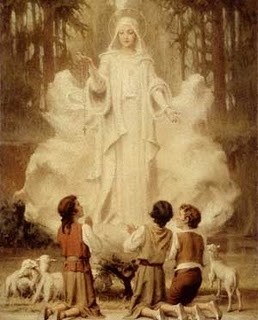
Suddenly there was a vivid flash of lightning. It came from the clear blue sky. At once the children stopped their play, for sudden thunder storms sometimes swept this district killing the sheep on the exposed fields. They ran to gather their sheep and drive them home quickly. But they were stopped by yet another vivid lightning flash. Terrified, they looked about them. To their amazement they saw to their right a lady of the greatest beauty standing, it seemed, upon one of the low oak trees. She appeared to be a girl of fifteen or sixteen, and was clothed in a long white garment with a white mantle over her hair, and this mantle was edged with a brighter light. She had a golden cord ending in a ball about her neck. Her beautiful face was serious and rather sad. Her hands were joined before her breast, and a rosary of white brilliant beads hung from her right hand. Her feet were partly hidden by the bright cloud which rested upon the tree.
Naturally, the children were astonished and afraid. But the Lady spoke to them kindly: “Have no fear. I will do you no harm.” Reassured by her gentleness and the sweetness of her voice, the children came a little closer. Then Lucia, the eldest, spoke: “Who are you?” she asked. “Where did you come from? What do you want?”
The Lady replied: “I come from heaven! I want you children to come here at this hour, on the 13th of each month, until October. Then I will tell you who I am.”
“You come from heaven! Shall I go there?” asked Lucia.
“Yes,” was the Lady’s reply, “but you must say the Rosary, and say it properly.”
“And Jacinta?”
“She will go, too.”
“And Francisco?”
“Yes, but he must say many Rosaries.”
Lucia made an enquiry about some little friends who had died: the Lady answered her.
Now, the Lady, in her turn, asked: “Are you willing to offer yourselves to God, and to bear all the sufferings He wishes to send you in reparation for the sins whereby He is offended, and as intercession for the conversion of sinners, and to make amends for all the blasphemies and offences committed against the Immaculate Heart of Mary?”
Lucia, answering in the name of all three, expressed their willingness. The Lady added: “You will have much to suffer then, but the grace of God will help you and give you the strength you need.”
Some moments later the Lady recommended them to recite the Rosary devoutly every day, to obtain peace for the world. Then she moved slowly towards the east and heavenwards, and disappeared in the blue vault of the sky. Lucia afterwards explained that all this had happened in the space of about ten minutes.
THE SEQUEL
When the Lady had disappeared the children were left looking at one another in astonishment. They could scarcely believe that it had not been all a dream. But all three had seen her. Francisco had not heard what she had said, but both the girls had caught every word. And Lucia had spoken to her! They got their sheep together and began to move back along the road for home. On the way they decided among themselves not to tell anyone of this strange experience. But the excitement of it all was too much for little Jacinta. That very evening as soon as she met her mother she sought to share the joyful news with her. Her mother questioned her and got the whole story from her. The next day she told Lucia’s parents. Soon it was the common gossip of the village.
OPPOSITION
The news was not received kindly by anyone. Everyone was incredulous except the children. Their parents particularly were determined that there should be no further nonsense of that sort. The three children were forbidden to tell such stories or to return to the field of Cova da Iria. However, Lucia was insistent that she must go back to the Lady at Cova on June 13, as she had promised. In desperation, her mother brought her to the parish priest and charged her: “Confess your lie so that the parish priest may tell the people on Sunday, and put an end to the whole affair.” Lucia still persisted: “But, mother mine, how can I say that I did not see what I saw?” The other children were brought along, too. Their pastor was kind to them, but deferred any decision till further evidence was available. While it might be some heavenly visitation, it was possible that it might be a deceit of the devil. Only time would tell. The many arguments and discussions which arose upset Lucia very much, and in the end, on June 12, she told the other children that she would not go with them to the field on the following day. They declared bravely that they were going, since they had promised the Lady. The following morning, June 13, Lucia went across to her cousins’ house and found them praying and crying. “Are you not going to Cova?” she asked them.
“We are afraid to go without you,” was their reply.
“Come, then, I am going!”
THE SECOND APPARITION
On this occasion, June 13, 1917, even though it was marked by special festivities in the village, as it was the feast of its patron, St. Anthony, the children were not alone in the field of Cova. Lucia’s father had gone ahead of the children, anxious no doubt, about the strange trespasser on his land. He was accompanied by sixty or seventy others, who had come along out of curiosity. Again it was midday, and the children, dressed in their best for the village feast, knelt in the shade of a large oak, and recited the Rosary devoutly with the people. After the Rosary the crowd noticed Lucia arrange her shawl over her head, “as if going into church,” and turn towards the east. With a gesture of surprise she cried out: “Look, that was a flash of lightning. The Lady is coming.” She rose and ran down to the smaller tree where the Lady had appeared the first time. “Madame,” said Lucia, “you have made me come here, what do you want of me?”
Again the Lady urged the daily recitation of the Rosary, and added: “I want you to learn to read, in order that I may be able to tell you what I want.” Continuing, she confided to Lucia the first secret message, which the child guarded faithfully. In reply to her request to take them all with her to heaven, the Lady said she would take Jacinta and Francis soon, but Lucia would have to remain longer on earth. “Jesus wishes to use you in making me known and loved. He wishes to spread in the world devotion to my Immaculate Heart.”
“Then I shall have to remain alone,” the child asked sadly.
“No, my child . . . I shall never abandon you. My Immaculate Heart will be your refuge and the way which shall bring you to God.”
As the Lady spoke these last words she seemed to be surrounded by a still brighter light than before. In this light, as the Lady opened her hands in a parting gesture, the children saw a vision of a heart, surrounded with thorns. * That was the end of the second vision. The sixty witnesses had not seen the Lady.
Those nearest the tree had heard Lucia’s conversation distinctly, and the Lady’s words, not clearly, but faintly, like the buzzing of a bee. They all had remarked that the bright mid-summer sun had been dimmed in some mysterious fashion for the ten minutes of Lucia’s vision. When they went up to the tree afterwards, out of curiosity, they noticed another strange thing. The upper branches were all bent over towards the east, as if the Lady’s garment had trailed over them as she went away.
THE THIRD APPARITION
Naturally, news of these strange doings in the field of Cova spread rapidly over the countryside. When the children came back on July 13, some five thousand country folk had gathered to witness what they could. Again the apparition came, and the Lady urged again the recitation of the Rosary for the ending of the war. On this occasion, after giving the children a glimpse of the horror of hell, Our Lady confided to Lucia a secret that she was not to reveal to anyone until such time as Our Lady herself would see fit. With her heavenly mother’s permission, Lucia gave this special message to the world when the clouds of the second world conflict were gathering, just twenty-one years later. It was contained in a letter she addressed to the Bishop of Leiria. In the course of this message Our Lady forewarned Lucia that “the world, because of its many crimes, will soon be chastised by war, famine and persecution against the Church and the Holy Father. . . . To prevent it I ask for the consecration of Russia to my Immaculate Heart, and for the Communion of Reparation on the first Saturday of each month. If my requests are heeded Russia will be converted and there shall be peace. Otherwise an impious propaganda will spread its errors through the world raising up wars and persecutions against the Church. Many will be martyred, the Holy Father will have much to suffer; several nations shall be wiped out. . . . The horizon is gloomy but here is a ray of hope-my Immaculate Heart shall triumph in the end.”**
At the conclusion of this vision the lady added: “When reciting the Rosary say after each decade: ‘Oh my Jesus, forgive us our sins, save us from the fire of hell, and lead all souls to heaven, especially those who most need Thy mercy.’ “
On this day Lucia, for the second time, asked the Lady who she was, stating many did not believe. The Lady’s reply was that the children were to come each month as promised, and that in October she would tell them her name, and work a great miracle which would convince all. Again most of the crowd present neither heard nor saw anything, but some of those near the children said that they had heard what Lucia had said. On this occasion, and others, many people declared that they saw a light cloud, like the smoke of incense, surrounding the tree and the children.
* Later the children understood that this was the Immaculate Heart of Mary, wounded by the sins of the world.
**The reader will find on page 23 of this pamphlet, that Pope Pius XII himself fulfilled the request for the consecration of the world to the Immaculate Heart of Mary in October, 1942.
Formal approval of the practice of a series of five Communions of Reparation on the first Saturday of consecutive months, together with the devout recitation of the Rosary and meditation for fifteen minutes on its mysteries was given by the Bishop of Leiria on September 13, 1939, this practice was recommended by the Hierarchy of Australia at their annual meeting, 1948.
Subscribe to:
Posts (Atom)